A system can meet its stated specifications and still reveal hazards when assumptions or interactions prove incomplete. That is a reason to examine requirements, safety assessment, operating context and continued feedback. It is not a reason to dismiss certification or treat an accident account as a complete certification record. The course’s historical Cyclone discussion should be read with the dated investigation and audit evidence, and each claim kept within what its source establishes.
Why this case matters
The Cyclone illustrates why a procurement label can conceal substantial developmental integration. A civil-derived starting point does not establish that every Canadian military function and interaction is covered by the original approval. Study the design and integration work separately from the contract description. That distinction also helps explain why airworthiness monitoring continues after entry into service.
Follow the evidence
The Program: A "MOTS" Helicopter That Wasn't
The CH-148 Cyclone is a militarized variant of the Sikorsky S-92/H-92 - a civil transport rotorcraft with a 14 CFR Part 29-derived pedigree - which places it in the ADSM Figure 1-3-3 category "Military Aircraft - Civil Derivative Hybrid": civil basis for the basic vehicle, military-unique certification work on top. Canada awarded the Maritime Helicopter Project contract in November 2004; Block 1 deliveries began June 2015, Block 2 from April 2018, IOC in June 2018, and final delivery in October 2023 - against an original in-service expectation years earlier. From Day 4's taxonomy you can already diagnose the structural risk: strategy (a) - "previously certified design, no TAA-certification-required modifications" - was the assumption; strategy (b) - "extensive DND-unique modifications" - was the reality. A fly-by-wire, ship-board, marinized helicopter with a Canadian mission system was never a MOTS buy.
| Date | Event | Airworthiness significance |
|---|---|---|
| Nov 2004 | Maritime Helicopter Project contract awarded (Sikorsky) | Developmental scope set - and underestimated (OAG paragraph 6.32) |
| 2010 | OAG Fall Report, Ch. 6 published | Audit finding ties developmental underestimate to certification scope and schedule |
| June 2015 | Block 1 deliveries begin | Interim capability under staged acceptance; provisional-style clearances |
| 2017 | Fleet grounded nine months after triple-redundant FBW software failure in initial acceptance trials | Resolved through operational and technical airworthiness management (OAA/TAA) |
| Apr 2018 / Jun 2018 | Block 2 deliveries / IOC | Fuller configuration accepted through the same clearance chain |
| 29 Apr 2020 | CH148822 accident; six crew lost | AIA investigation; FSIR finds latent control-law hazard in a compliant design |
| Nov 2021 | Tail cracks (ESM-antenna loads) found; repaired with Sikorsky | Continuing airworthiness: design change certification before fleet implementation |
| Oct 2023 | Final aircraft delivered | Nineteen years from contract to complete fleet - the cost curve of a developmental derivative |
The Clearance Chain Applied to the Cyclone
Run the Cyclone through Day 3's instrument map. The TAA's type design work - hybrid Certification Basis, compliance program, credit for Sikorsky's civil certification through TDE - fed the DND Type Certificate and per-aircraft flight authority. The TAC (with provisional forms where requirements were incomplete), the OAA's OAC, and the AIA's IAC fed the AA's Airworthiness Clearance; the ARB - co-chaired by OAA and TAA - carried the fleet's clearance through its annual reviews; and Release to Service proceeded in stages matched to Block 1 and Block 2 configurations. The public record documents the pattern at the program level: interim and provisional clearances accepted documented residual risk while compliance work continued - exactly the machinery TAM Part 2, Chapter 3 and Part 5, Chapter 1 exist to manage, and exactly what the ADM(RS) 2017 evaluation warned against over-using (Records of Airworthiness Risk Management clearing new aircraft should be the exception, not the business model).
Certification Consequences in Service
The hybrid basis produced hybrid compromises. The main gearbox run-dry capability was reduced to be "in line with all other RCAF aircraft," with Sikorsky stating that procedures "will be established to satisfy the required airworthiness regulations, including the civil run dry requirement" - the civil FAR 29-derived strand of the basis driving a specific military design concession. In 2017, a triple-redundant fly-by-wire software failure forced the RCAF to ground the fleet for nine months during initial acceptance trials, resolved "through the operational and technical airworthiness management of the fleet" - which is to say, through the OAA/TAA machinery of Module 1, not through a procurement work-around. Continued airworthiness kept the pattern alive: November 2021 tail cracks attributed to ESM-antenna structural loads were repaired with Sikorsky, and the post-accident flight-control software redesign was taken straight into "airworthiness certification of the design change" under TAM Part 3, Chapter 2 before fleet-wide implementation.
Continued Airworthiness: The Contractor Dimension
The Cyclone also teaches who holds the continuing-airworthiness levers on a developmental foreign design. The in-service support contract with Sikorsky - the OEM - has been extended to 2038 (a $5.8B ISS arrangement against a $3.2B acquisition, per DND's 2023 parliamentary briefing), with the manufacturer directly involved in the tail-crack repairs and the flight-control software redesign certification. This is the DND pattern for complex foreign types: the fleet's technical authority functions sit inside a TAA-regulated framework, but the design knowledge sits with the OEM, so certification of design changes runs through contractor certification arrangements inside accredited/acceptable organizations - the Day 11 topic - rather than through any assumption that the original foreign certification will maintain itself.
Twelve-minute project workshop
Training scenario — not an actual project decision
Training scenario: a fictional maritime helicopter receives revised automatic-control software and a changed operating procedure. The development team reports successful nominal tests. An operator reports unexpected behaviour during an unusual manoeuvre. The project manager asks whether nominal compliance testing closes the matter. Explain the information you need and how design, procedures and continued monitoring interact without proposing an unauthorized flight test.
- Spend three minutes drawing the boundary between the baseline helicopter and military integration.
- Spend four minutes listing nominal, degraded and interaction conditions the safety argument should address.
- Spend three minutes linking an in-service report to configuration, investigation and possible corrective work.
- Spend two minutes separating contract milestones, technical approval and operating readiness.
Compare your reasoning
Nominal results may be useful while leaving an interaction question open. Establish the configuration, event conditions, relevant requirements and assumptions before choosing a response. Continued airworthiness includes learning from service evidence, controlling changes and implementing applicable corrective action. It does not give a course learner authority to determine the real fleet’s flight restrictions or approval status.
Keep your worksheet as an optional learning aid. It is not submitted or graded. The practice below has no pass mark and does not affect core course completion.
Sources and further reference
- Technical Airworthiness Manual
TAM — current manual and structure
- Airworthiness Design Standards Manual
ADSM — recognized standards and certification approaches
- CH148822 Cyclone investigation epilogue
RCAF, May 2021 — historical investigation findings
Continuing airworthiness keeps the argument current
The evidence story continues after entry into service. Feed new information back into the assessment rather than treating the original certificate as the final answer.
Observe service
Usage, defects and findings
Capture what the fleet is actually experiencing, including usage that may differ from original assumptions.
Assess significance
Safety, configuration and assumptions
Determine which design, maintenance or operating assumptions may be affected and what assessment is needed.
Control the response
Applicable change or corrective process
Follow the applicable process for a change, instruction or other corrective action. Keep the evidence tied to its defined configuration.
Align the records
Configuration and support information
Ensure the aircraft, records and applicable instructions describe a consistent state.
Monitor again
Verify and learn from the outcome
Observe the result and continue monitoring. This feedback loop is a learning model; actual release requirements come from the applicable rules.
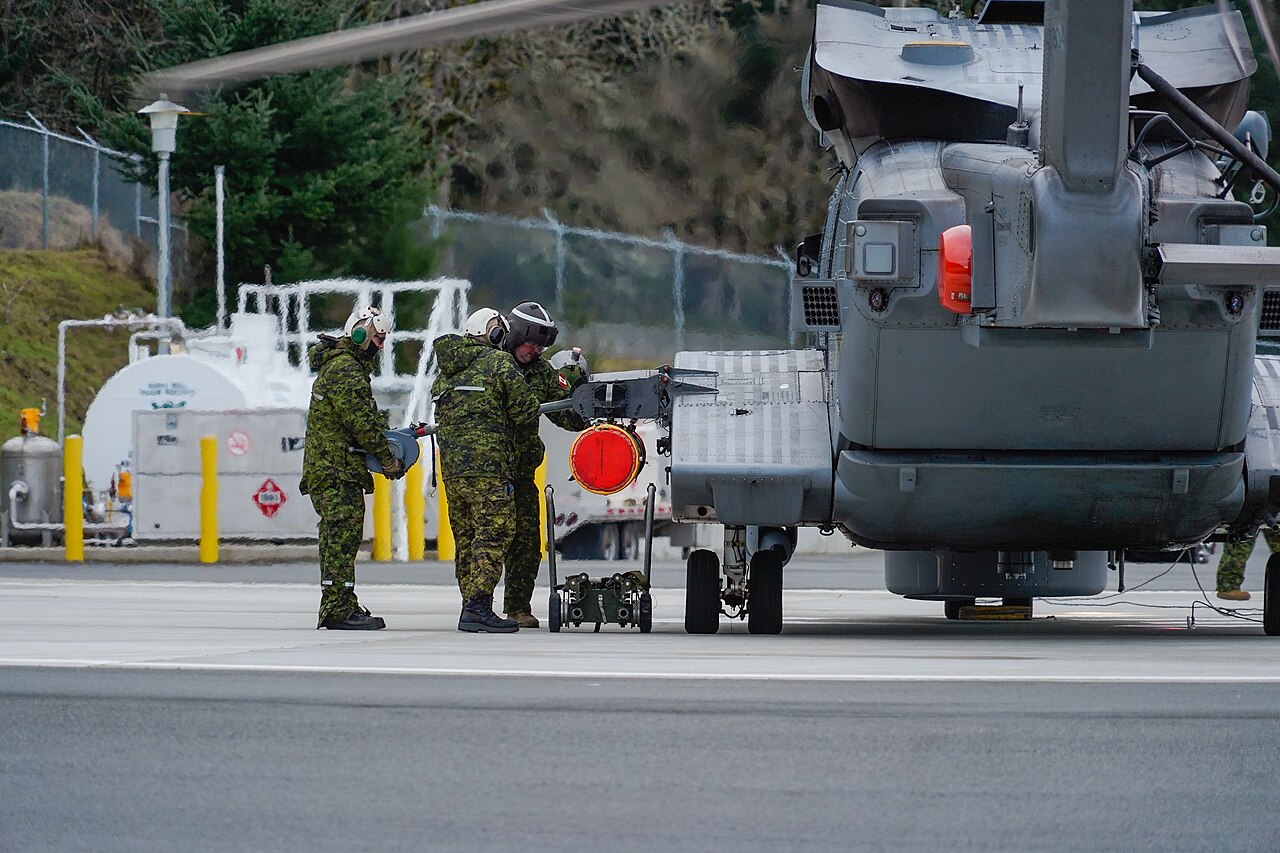
CH-148 Cyclone
Mission equipment interacts with the aircraft, its procedures and its operating environment. Those interfaces are part of the integration story.