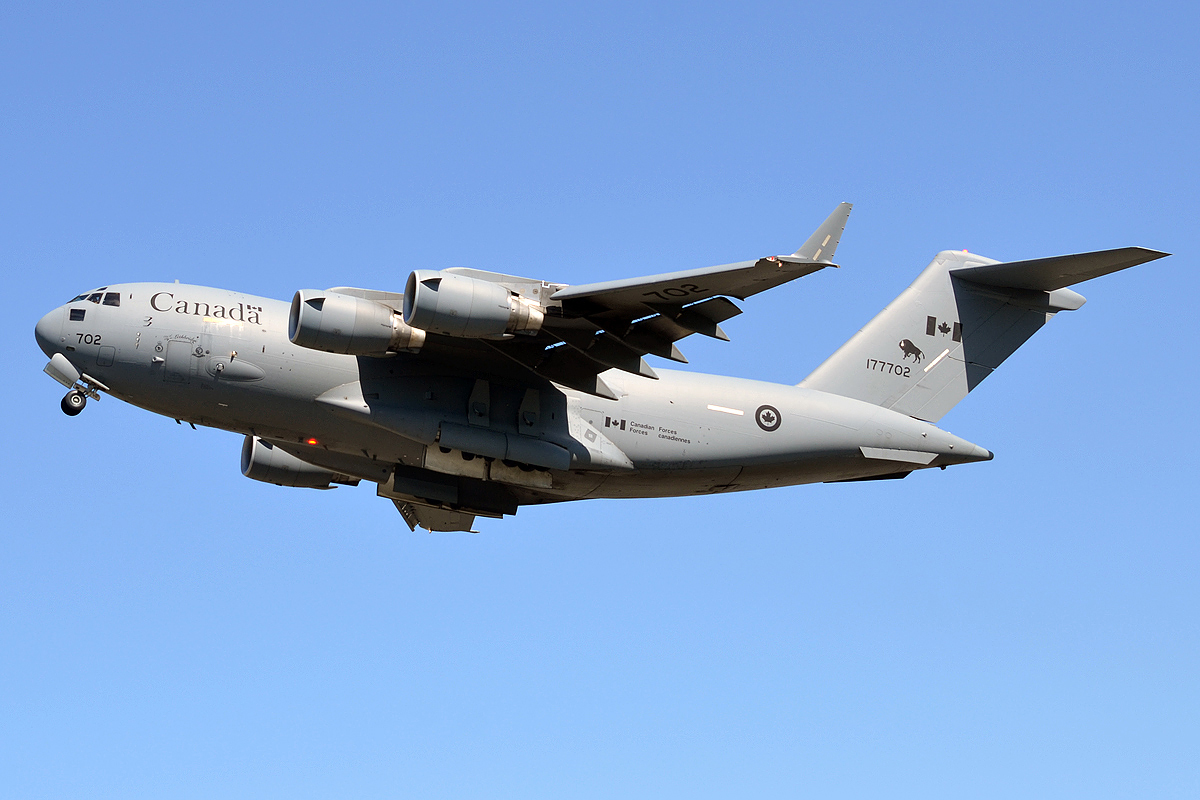
A baseline has value when the programme can define what it includes and connect it to evidence. The aircraft’s model name alone is insufficient. Compare hardware, software, role, environment, support assumptions and change state. Different acquisition channels may affect access to data and coordination, but a contract channel is not an airworthiness certificate. The ADSM provides the framework for using established design evidence; project-specific conclusions must follow the available record rather than a generic off-the-shelf label.
Why this case matters
An established military transport is a useful contrast with a heavily developmental integration project. The CC-177 course example helps explain how prior design work can form a starting point for Canadian approval. The practical lesson is bounded credit: identify the baseline, establish relevant evidence and examine any Canadian differences. An established design does not mean Canadian responsibility disappears.
Follow the evidence
The Basic Vehicle / Baseline Aircraft Contracting Concept
Most CAF acquisitions start from a design someone else already certified, and DND's contracts say so: "The contracting term that DND uses in aircraft acquisition projects to describe a previously certified aircraft design is 'Baseline Aircraft' or 'Basic Vehicle' (BV). The contract will require the aircraft prime contractor to design and implement any DND-unique modifications" (ADSM 1.3.10). The certification-basis consequence follows: "for those areas of the BV that are not affected by the DND-unique modifications [the basis] will remain unchanged from the certification basis approved by the Original Certification Authority (OCA)"; for the modifications, the basis "may well be a mix of FARs, plus extracts from MIL-HDBK-516, as well as special conditions" (ADSM 1.3.10(b)). This is the practical architecture of almost every modern CAF fleet: an inherited foundation for the unchanged design, and a tailored Canadian basis - civil code extracts, military-code extracts, Special Conditions - for the missionized content. Your engineering problem as the applicant is to draw the affected/unaffected boundary defensibly, because everything on the wrong side of that line carries the wrong amendment level or the wrong standard.
Note the deliberate "and/or" in S3(4). A clean-sheet developmental type uses route (a) alone: select the applicable airworthiness code from the ADSM's recognized menu and build the full basis from it. A pure MOTS acquisition uses route (b) alone: adopt the OCA's approved basis wholesale. Everything in between - which is most of the CAF inventory - mixes the two: the OCA basis carries the unchanged basic vehicle while recognized-code criteria address what the OCA basis never contemplated. The certification-basis document should therefore read as a map, not a list: for each area of the design, which source applies, at what amendment or issue level, with what rationale. That mapping discipline is what lets a reviewer - or, years later, a design change engineer under Part 3, Chapter 2 - reconstruct why any given requirement is in the basis at all.
Three Acquisition Strategies, Three Basis Architectures
ADSM 1.3.10 formalizes three acquisition-project strategies, and each implies a different certification-basis build. Strategy (a) - a previously certified design with no modifications requiring TAA certification (COTS/MOTS): the DND fleet's basis is simply the one the OCA approved; the ADSM's examples are the CC-177 Globemaster and CC-144 Challenger. Strategy (b) - a previously certified design plus extensive DND-unique modifications, "the most common" case: the BV basis is retained for untouched areas and the DND-unique changes are certified to a tailored mix. Strategy (c) - an entirely new type design: a full certification basis is developed from a TAA-recognized code and agreed with the TAA. ADSM Figure 1-3-3 cross-references these strategies against fleet categories: passenger-carrying civil derivatives (CC-150, CC-144, CT-142, CC-138) on civil certification bases; military civil-derivative hybrids (CH-146, CH-149, CH-148, CC-130J, CC-177, CP-140); and military-code aircraft (CH-147F, CF-188, CT-155, UAS).
| Strategy | Certification basis build | TDE role | ADSM examples |
|---|---|---|---|
| (a) Previously certified design, no TAA-certification-required modifications (MOTS) | OCA's approved basis adopted as the DND basis | Credit examination of the OCA certification; applicability check on CRE | CC-177 Globemaster, CC-144 Challenger |
| (b) Previously certified design + extensive DND-unique modifications (most common) | BV/OCA basis for unaffected areas + tailored mix (FARs + MIL-HDBK-516 extracts + Special Conditions) for modifications | Credit for the basic vehicle; DND-unique content certified under Part 3, Ch. 2 / Part 2, Ch. 1 | CH-147F (MIL-HDBK-516-derived basis for DND-unique changes); CH-148 (civil-derived hybrid) |
| (c) Entirely new type design | Full basis developed from a TAA-recognized code, agreed with the TAA | None - no prior certification to credit | Developmental types; certain UAS |
The fleet-category map deserves a closer read, because it predicts the basis architecture before any contract is signed. Passenger-carrying civil derivatives - CC-150 Polaris, CC-144 Challenger, CT-142 Dash 8, CC-138 Twin Otter - sit on civil certification bases, and for these fleets the TAA's recognition of TCCA/FAA/EASA civil certification work does most of the lifting. The military civil-derivative hybrids - CH-146 Griffon, CH-149 Cormorant, CH-148 Cyclone, CC-130J, CC-115 Buffalo, the CC-130E/H, CC-177 and CP-140 Aurora - all carry some combination of civil-derived basic vehicle and military-unique certification content, which is why the hybrid category produces the most demanding basis-assembly work. The military-code aircraft - CH-147F, CF-188, CT-155 Hawk, CT-114 Tutor and UAS - rest on military design standards or weapon-system-specification pedigrees, with the ADSM's legacy-fleet provisions (below) supplying the basis logic. When you are handed a new fleet file, the first professional act is to locate it on this map; most of your certification-basis strategy follows from that placement.
Two boundary instruments complete the basis toolkit. Exemptions and deviations: where the assembled basis cannot be met literally, relief runs through TAM Part 5, Chapter 9, resting on the MND's exemption power in Aeronautics Act s. 5.9 - relief by instrument, with conditions, never by acquiescence. The Acceptable Level of Safety (ALOS): the program's safety objective concept informs standard selection and, downstream, the risk-management treatment of any non-compliance that survives into service via a Record of Airworthiness Risk Management. Neither instrument dilutes the basis; both document, at TAA level, exactly where and why the design departs from it - which is the difference between a managed deviation and an undiscovered one.
Twelve-minute project workshop
Training scenario — not an actual project decision
Training scenario: a fictional transport acquisition uses an established foreign military baseline, with one Canadian communications installation and a different support arrangement. A summary report covers the original aircraft. The installation designer provides drawings but no integration report. The project team wants to avoid repeating work already completed. Your review should show where useful credit saves effort and where the package remains incomplete.
- Spend three minutes defining the baseline and the two Canadian differences.
- Spend four minutes mapping applicable prior evidence and remaining integration questions.
- Spend three minutes identifying data access and configuration information needed for continued support.
- Spend two minutes comparing your conclusion with the CH-147F exercise without assuming identical pathways.
Compare your reasoning
An established baseline can reduce duplicated work when its applicability is established. The new installation still needs an appropriate design and integration argument, and continued support needs reliable information about the approved configuration and subsequent changes. The fictional package does not establish what the actual CC-177 programme accepted. Use the ADSM framework and clearly distinguish framework reasoning from a published project decision.
Keep your worksheet as an optional learning aid. It is not submitted or graded. The practice below has no pass mark and does not affect core course completion.
Sources and further reference
- Technical Airworthiness Manual
TAM — current manual and structure
- Airworthiness Design Standards Manual
ADSM — recognized standards and certification approaches
A TDE asks two different questions
Acceptability + applicability support bounded credit. A TDE establishes credit; it does not itself grant a Canadian airworthiness approval.
Acceptability
Can we rely on the prior work?
Consider the original standards, processes and procedures. Recognition of an authority can support confidence in that work.
Applicability
Does it fit our aircraft and use?
Compare the Canadian configuration, role and environment with the scope and assumptions of the prior evidence.
Bounded credit
What is credited, excluded or still needed?
Record the credit and its limits. Additional work can remain where Canadian differences or evidence gaps are identified.
Canadian approval
Which approval process uses that credit?
Use the credit in the applicable Canadian type-design or design-change approval process. Do not treat credit as the approval itself.
CC-177 Globemaster III
Use the transport example to distinguish evidence for an established baseline from evidence needed for differences or modifications.